

In the modern digital landscape, a website is more than just a marketing tool; it is a legal entity. Whether you are running a simple personal blog or a multi-national e-commerce platform, failing to include specific legal pages can lead to hefty fines, blacklisting by search engines, and a total loss of consumer trust.
As the best SEO company in Faridabad, we often remind our clients that search engines like Google prioritize “E-E-A-T” (Experience, Expertise, Authoritativeness, and Trustworthiness). Legal transparency is a massive trust signal that directly impacts your rankings.
Here is a detailed breakdown of the legal requirements for different types of websites across major global jurisdictions.
1. Requirements By Website Type
Personal Blogs
Even if you aren’t selling anything, you are likely collecting data (via cookies, newsletters, or comments).
- Privacy Policy: Mandatory if you collect even an email address.
- Disclaimer: Essential if you give advice (health, finance, legal) or use affiliate links (FTC requirement).
- Comment Policy: To protect you from liability regarding user-generated content.
Business Websites
For service-based businesses, transparency is the key to lead generation.
- Privacy Policy & Cookie Policy: To explain how client data is handled.
- Terms and Conditions (T&C): To define the rules of using your site and the limitations of your liability.
- Contact Information: Physical address and registration details (often required by law for businesses).
E-commerce Websites
These are the most heavily regulated due to financial transactions.
- Terms of Service (ToS): Must include shipping, returns, refunds, and cancellation policies.
- Payment Security Policy: How you handle credit card data (PCI DSS compliance).
- Warranty Information: Specifics on product guarantees.
2. Regional Legal Analysis
The best Digital Marketing Company in Faridabad ensures that your brand isn’t just visible, but globally compliant. Here is how requirements differ by region:
USA (CCPA, COPPA, and FTC)
The US doesn’t have a single federal privacy law, but state laws like the CCPA (California) act as the gold standard.
- ADA Compliance: Websites must be accessible to people with disabilities.
- FTC Disclosures: If you are paid to review a product, you must clearly state it.
- COPPA: Strict rules if your site attracts children under 13.
European Union (GDPR & ePrivacy)
The GDPR is the world’s strictest privacy law.
- Explicit Consent: You cannot track users with cookies until they click “Accept.”
- Right to be Forgotten: Users must have an easy way to request data deletion.
- Data Processing Agreements: If you use third-party tools (like Analytics), you must disclose them.
Australia (Privacy Act 1988 & ACL)
- Australian Consumer Law (ACL): You cannot have a “No Refund” policy; consumers have an inherent right to repairs or replacements for faulty goods.
- Privacy Principles: Mandatory for businesses with a turnover exceeding $3M, but recommended for all.

South East Asia (PDPA)
Countries like Singapore, Thailand, and Malaysia follow the PDPA (Personal Data Protection Act).
- Purpose Limitation: You can only collect data for the specific reason you stated to the user.
- DPO: Many businesses are required to appoint a Data Protection Officer.
India (DPDP Act 2023)
India has recently stepped up its game with the Digital Personal Data Protection (DPDP) Act.
- Notice and Consent: Websites must provide a clear notice in plain language (and multiple Indian languages if applicable) before collecting data.
- Significant Data Fiduciaries: Large platforms have extra obligations regarding audits and data protection impact assessments.
- Consumer Protection (E-commerce) Rules: Requires clear display of the “Country of Origin” and details of the Grievance Officer.
[Image comparing global data privacy laws like GDPR, CCPA, and DPDP Act]
3. Why Compliance Is An SEO Strategy
You might wonder why the best SEO company in Faridabad is discussing legalities. The answer lies in User Experience (UX).
- Reduced Bounce Rates: Users feel safer on sites with clear policies, leading to longer session durations.
- Algorithm Favoritism: Google’s “Quality Rater Guidelines” specifically look for “About Us” and “Contact” pages to verify the legitimacy of a business.
- Global Reach: If your site isn’t GDPR compliant, you may be blocked or penalized in European search results.
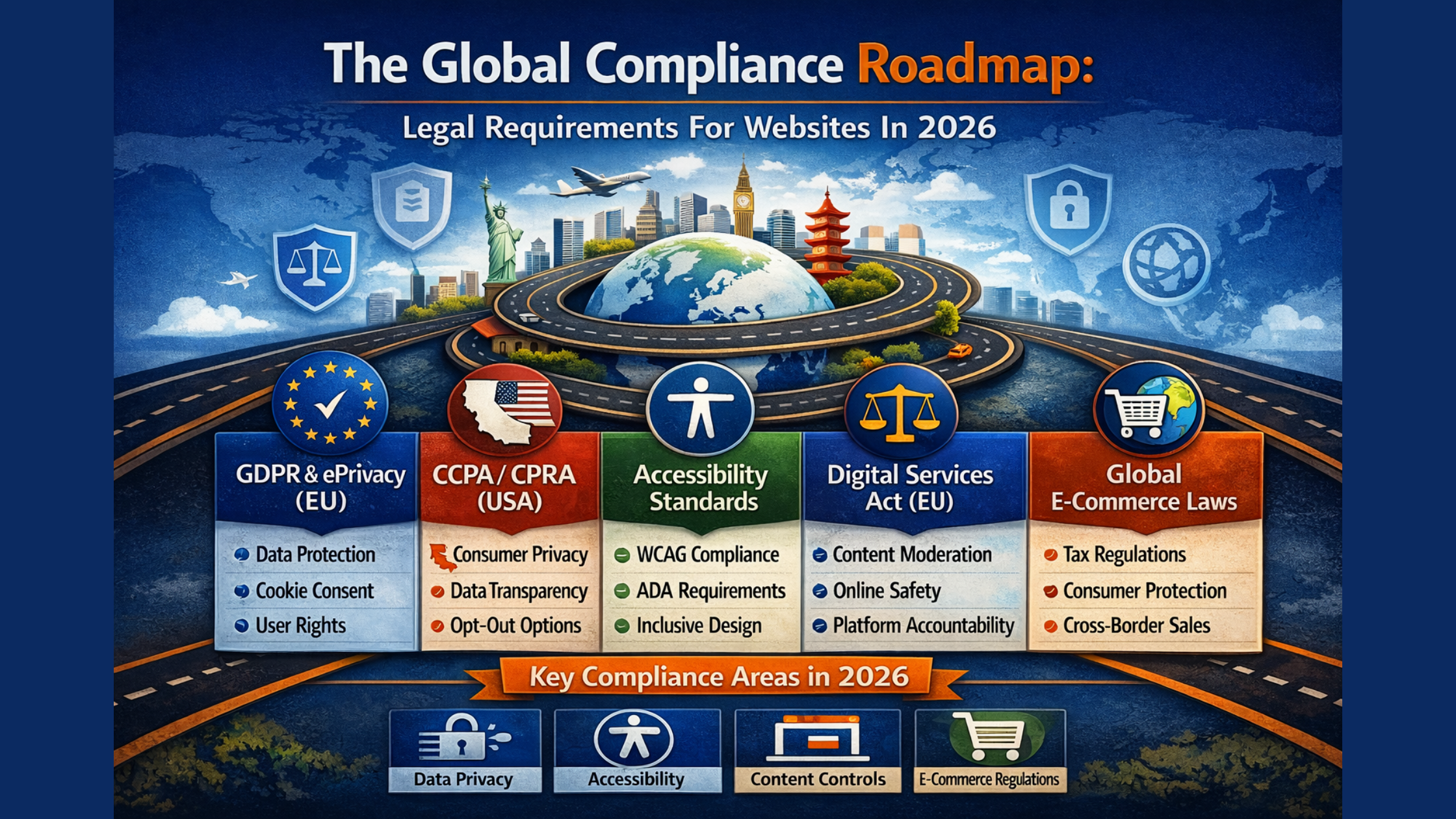
FAQs: The Global Compliance Roadmap – Legal Requirements For Websites In 2026
1. What is website compliance in 2026?
Website compliance in 2026 means following global laws related to data privacy, user consent, accessibility, content moderation, and digital transparency to legally operate online.
2. Which privacy laws should websites comply with in 2026?
Major laws include GDPR (EU), CCPA/CPRA (USA), and other regional data protection regulations that govern user data collection, storage, and consent.
3. Is a privacy policy mandatory for websites?
Yes. Most countries legally require websites to display a clear privacy policy explaining how user data is collected, used, and protected.
4. Are cookie consent banners still required in 2026?
Yes. Cookie consent remains mandatory under GDPR and similar laws, especially for tracking, analytics, and marketing cookies.
5. What accessibility standards must websites follow?
Websites should comply with WCAG 2.1 or 2.2 (Level AA) to ensure accessibility for users with disabilities and to avoid legal risks.
6. Does accessibility compliance affect SEO?
Yes. Accessible websites improve user experience, site structure, and engagement—factors that indirectly support better search engine rankings.
7. What is the Digital Services Act (DSA)?
The DSA regulates online platforms in the EU, focusing on content moderation, user safety, transparency, and platform accountability.
8. Do e-commerce websites have additional legal requirements?
Yes. E-commerce sites must follow tax regulations, consumer protection laws, refund policies, and cross-border trade compliance rules.
9. Does website compliance differ by country?
Yes. Legal requirements vary by region, but global websites must comply with laws applicable to their users’ locations.
10. How often should website compliance be reviewed?
At least once a year or whenever new laws, technologies, or business expansions occur.
Final Thoughts
Navigating international law can be daunting, but it is a non-negotiable part of doing business in 2026. Whether you are targeting local customers in Haryana or a global audience, your legal pages must be up-to-date.
As the best Digital Marketing Company in Faridabad, we help brands build a “Digital Republic” that is safe, authoritative, and high-ranking. Don’t let a missing “Privacy Policy” be the reason your brand gets sued or de-indexed.
Need a technical audit to see if your website meets global legal standards? Contact us today for a comprehensive Digital Health Checkup.